


Written by Anna-Lena Hasselder
8 minutes read
A changing humanitarian moment
Across the humanitarian sector, calls for localisation have grown steadily louder. At its core, localisation seeks to place those closest to crises, including local organisations and affected communities, at the center of the humanitarian response, recognising their contextual knowledge, leadership, and long-term presence. International frameworks such as the Grand Bargain Agreement have reinforced the need to shift resources, decision-making power, and leadership toward local actors. Yet translating these commitments into practice remains challenging, as questions around risk, financing, accountability, and institutional capacity continue to shape how, and to what extent, local actors are able to lead in practice.
Syria offers a particularly important case for understanding these dynamics, especially in light of recent political shifts and the gradual reconfiguration of governance and humanitarian engagement across the country. After more than a decade of conflict, local organisations and communities have often been the first, and sometimes the only, actors able to respond to urgent needs. As the political landscape evolves and international attention returns to different parts of Syria, there is renewed interest in how locally led approaches can be strengthened rather than sidelined.
Over the past year, we had the opportunity to shadow a large humanitarian consortium working in Northeast Syria (NES) that was exploring bottom-up, community-centred programming. The consortium supported several community-based organisations (CBOs) to implement Water, Sanitation and Hygiene(WASH) projects while employing approaches such as the Change-Oriented Approach(COA) and supporting community-led response (sclr). This experience offers a rare window into what localisation can look like in practice, and the challenges that still need to be addressed to advance it further.
What are COA and sclr?
Sclr is based on a simple premise: communities are not only recipients of aid, but active agents capable of shaping their own responses. Closely linked to this is the consortium’s Change-Oriented Approach (COA),which focuses on creating structured spaces for dialogue between communities, local organisations, and other stakeholders to identify priorities and co-design solutions. Rather than designing projects externally and delivering them to communities, COA and sclr shift the starting point of programming by engaging communities from the outset to define what matters most and how it should be addressed.
In practice, COA creates the conditions for collective reflection and prioritisation. Through facilitated discussions, communities identify key challenges and explore possible responses grounded in their own realities. Sclr then builds on this process by supporting community groups to translate these priorities into action, often through small grants and locally led initiatives.This creates a continuous cycle in which dialogue informs action, and learning feeds back into future decisions.
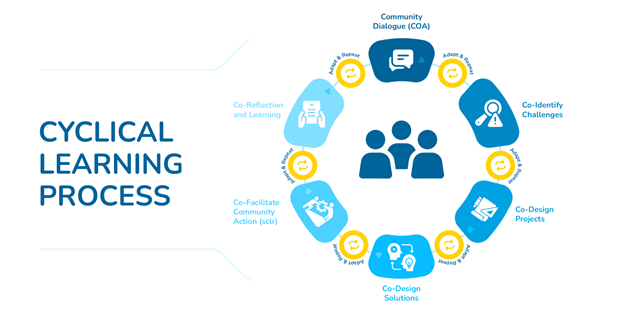
Communities identify challenges, co-design responses, and take action, while continuously reflecting and adapting based on what works in practice.
This cyclical process challenges more traditional, linear modelsof aid delivery. Instead of moving from assessment to implementation in a fixedsequence, COA and sclr enable continuous adaptation, grounded in communityfeedback and lived experience. In this sense, they resemble participatory action research approaches, where communities analyse, act, and learn iteratively, strengthening both the quality of interventions and local ownership over time. This not only improves the relevance of interventions, butalso strengthens local ownership and accountability throughout the process.
Local Populations as natural problem solvers
The experience of COA and sclr in Northeast Syria is best understood within the broader realities of the region. Over more than a decade of conflict, communities and local organisations in NES have had to respond to needs with limited and often inconsistent external support due to ongoing sanctions and security concerns. In this context, they have played a central role in maintaining essential services, coordinating assistance, and navigating complex political and security dynamics themselves.
Through the consortium’s work, this existing capacity became more visible and was further strengthened. Following an organisational capacity assessment, several CBOs received targeted training and support, enabling them to work more effectively with communities in implementing small-scale WASH initiatives across Northeast Syria. These initiatives ranged from improving water access in neighbourhoods to upgrading hygiene facilities in schools and community spaces. In this regard, what stood out was not only what was implemented, but how it was shaped. Rather than being predefined externally, interventions emerged through dialogue with residents, who identified priorities and proposed practical responses grounded in their daily realities.As one community member mentioned:
“We talked about the difficulty of fetching water, especially in the summer, and our voices were communicated to the entity implementing the projects”
This reflects a broader pattern: local populations are often natural problem solvers. With limited resources, they have repeatedly demonstrated an ability to transform small inputs into meaningful outcomes. The role of humanitarian actors, therefore, is not to replace these systems, but to understand how they can be strengthened and supported. As one practitioner involved in the programme explained:
“We don’t want to turn them into mini-INGOs operating with our standards. We want them to use their own way. If it is working already, don’t touch it.”
Approaches such as sclr help create the conditions for this shift by connecting locally grounded knowledge and practices with wider humanitarian systems. In doing so, they offer a way to move beyond externally driven models of aid delivery toward approaches that recognise and build on the capacities already present within communities, an important step in advancing localisation in contexts such as NES.
Structural barriers to localisation remain persistent
Yet, while community-led approaches show considerable promise,operationalising localisation continues to face structural challenges. One ofthe most persistent relates to risk. In humanitarian action, risk is multidimensional, encompassing security, fiduciary, reputational, and compliance-related concerns that are unevenly distributed across the system.Local organisations and CBOs often carry the greatest physical and operational risks, working in fragile and uncertain environments, while international organisations tend to focus on fiduciary and compliance risks shaped by donor requirements. Donors, in turn, are primarily concerned with financial and reputational exposure, particularly in politically sensitive contexts such as Syria.
These dynamics directly shape funding mechanisms and partnershipmodels. Complex proposal processes, strict compliance requirements, and layered approval systems can limit smaller organisations’ ability to access resources directly. At the same time, international actors often remain positioned as intermediaries, reinforcing a vertical “waterfall” model of aid delivery in which decisions and resources flow downward, while operational responsibilities concentrate at the local level. The result is a system in which local organisations shoulder significant responsibility for implementation, but remain constrained in their ability to access funding or shape programming independently.
In NES, these challenges are further compounded by the absence ofa functioning banking system. Many organisations rely on local currency transactions and informal transfer mechanisms such as hawala, where trusted agents facilitate the movement of funds across borders and within the country.While widely used and often more reliable than formal channels, these systems require careful management to mitigate risks related to cash handling, scrutiny from authorities, and exchange rate volatility. Practical lessons from the project and wider humanitarian practice highlight the importance of sequencing transfers in smaller instalments, working through trusted intermediaries, and aligning disbursement timelines with procurement processes to minimise prolonged cash exposure.
At the same time, challenges extend beyond financial systems. Even where community-led approaches have reshaped how aid is delivered, longer-term sustainability remains uncertain. WASH programming, including at community level, continues to be shaped by short-term project cycles that often leave limited space for maintenance, system strengthening, and sustained investment.As one advisor noted:
“Maybe not every CBO will be sustainable alone, but together they might form a strong ecosystem.”
This points to the importance of collaboration, where networks of CBOs, communities, and supporting actors can collectively sustain services that individual organisations may struggle to maintain alone. The consortium we shadowed contributed to this emerging ecosystem by strengthening community agency and local delivery capacity. Nonetheless, the remaining challenge lies in aligning political, financial, and institutional systems to support these actors over time, particularly as Syria moves through a period of transition.
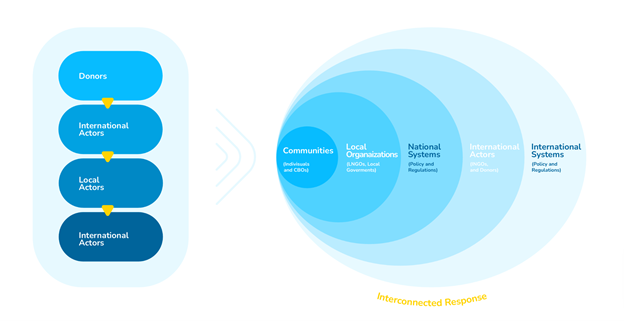
While humanitarian response is often structured as a vertical flow of funding and decision-making, according to localisation theory, it should operate across interconnected levels: from communities and local organisations to national and international systems. Recognising these interdependencies is key to redistributing risk, responsibility, and decision-making more equitably.
An ecosystem perspective helps explain why current risk dynamics remain uneven. While funding and formal accountability often flow throughhierarchical channels, operational realities are shaped across multiple levelssimultaneously. Local actors navigate risks linked to implementation, security, and community trust, while international actors operate within regulatory and financial constraints. Localisation therefore requires more than shifting resources: it involves recognising and engaging with an interconnected system in which risk, knowledge, and decision-making are distributed across actors and must be managed collectively.
What the Sector can learn
The experience of community-led programming through COA and sclr in Northeast Syria offer several lessons for practitioners and donors interested in advancing localisation.
1. Localisation requires rethinking how risk is shared:
Current humanitarian architectures tend to distribute risk unevenly, with local actors absorbing many operational risks while decision-making authority remains elsewhere. More balanced approaches to risk-sharing are needed if localisation commitments are to translate into practice.
2. Communities and local organisations already possess significant capacity:
Years of operating in complex environments have enabled local actors in NES to develop adaptive and context-specific ways of working. Strengthening these systems may be more effective than attempting to replicate external models of organisational development, offering an opportunity for localisation to become the dominant paradigm for working with organisations inSyria.
3. Funding mechanisms remain acritical barrier.
Complex donor procedures, proposal requirements, and compliance frameworks often limit the ability of smaller organisations to access international funding directly. In NES, these challenges are further compounded by banking restrictions and reliance on local currency and informal transfer systems such as hawala. Simplifying funding access and supporting trusted intermediary models can help bridge this gap, enabling local organisations to participate more fully in humanitarian programming while managing financial risks more effectively.
Creating space within the Global Aid Architecture
For more than fourteen years, local organisations and communities across NES have played a central role in sustaining humanitarian responses. As political dynamics evolve and international actors re-engage more actively in Syria, there is an opportunity, and a responsibility, to ensure that these locally developed systems are not overshadowed by more centralised models of aid delivery.
Approaches such as sclr offer one way of thinking differently about humanitarian programming, allowing localised knowledge to feed back into the global chain of humanitarian aid. By recognising communities as partners rather than beneficiaries, community-centred approaches create space for locally grounded solutions that are both relevant and sustainable.
The experience of Northeast Syria suggests that localisation isnot something that needs to be introduced from the outside; in many places, it is already happening. The question now is how the wider humanitarian system can support it. In this sense, the lessons emerging from Syria carry relevance far beyond the country itself.Translating these insights into global policy discussions, funding mechanisms, and humanitarian practice will be essential to creating an ecosystem in which locally led action can genuinely flourish. While initiatives such as the GrandBargain have elevated localisation on the global agenda, many of the forums where humanitarian priorities and funding architectures are shaped remain dominated by international actors. Ensuring that local organisations and communities have a stronger voice in shaping these discussions will be essential if the next generation of humanitarian programming is to place people on the ground, not international systems, at its centre.
→ Want to read more about the project? Click here
→ Want to stay informed? Follow us on LinkedIn

